Winter Intake Open!!



Date: Mar 10, 2026 Day: Tuesday
Physics is considered one of the most challenging subjects for students preparing for NEET 2026. Many medical aspirants find Physics difficult because it involves conceptual understanding, formulas, and numerical problem-solving.
However, with the right preparation strategy and knowledge of Physics chapter wise weightage, students can focus on the most important topics and improve their chances of scoring high marks.
Students who plan to pursue medical education and receive guidance from World Center for International Education and Career (WCIEC) can benefit greatly from understanding the important Physics chapters for NEET. This helps in building a structured study plan and managing time efficiently.
In this article, we will explain the Physics chapter wise weightage for NEET 2026, important topics, and preparation strategies.
In NEET, Physics plays an important role in determining a student’s final rank.
Key details of the Physics section:
Total Questions: 50
Questions to Attempt: 45
Total Marks: 180
Marks per Question: 4
Since Physics includes many numerical problems, focusing on high-weightage chapters is essential for effective preparation.
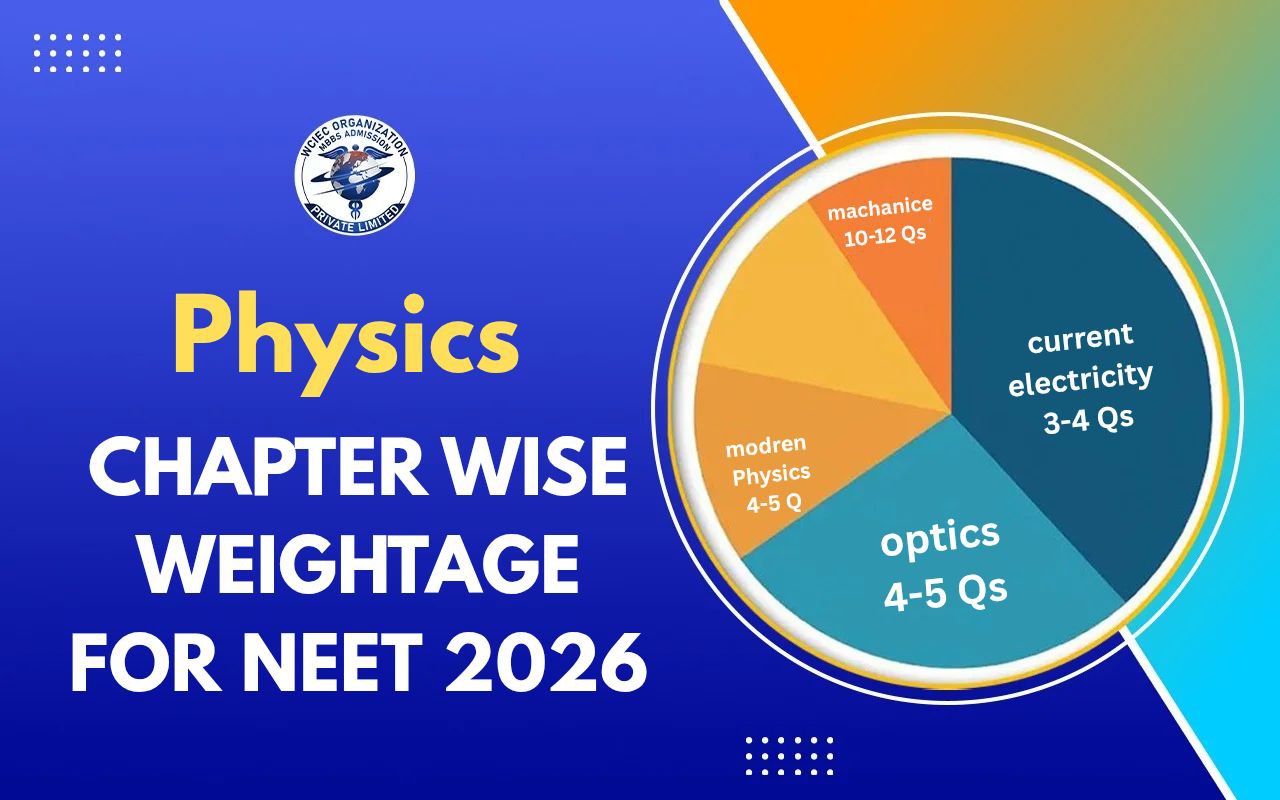
Based on analysis of previous NEET exams, here are the important chapters and their expected weightage.
Mechanics forms the foundation of Physics and usually has the highest number of questions in NEET.
Important topics include:
Laws of Motion
Work, Energy and Power
Rotational Motion
Gravitation
Centre of Mass
Kinematics
One of the most fundamental principles in mechanics explains the relationship between force and acceleration.
Students should practice numerical problems regularly from mechanics because these questions appear frequently in NEET.
Expected Questions: 10–12
Current electricity is another high-scoring chapter in Physics.
Important topics include:
Electric Current
Electrical Resistance
Electric Circuits
Electrical Power
A key concept used in circuit analysis is Ohm’s law.
Many NEET questions involve solving circuit diagrams and calculating voltage or current.
Expected Questions: 3–4
Electrostatics deals with electric charges and the forces between them.
Important topics include:
Coulomb’s Law
Electric Field
Electric Potential
Capacitors
The force between two electric charges can be calculated using Coulomb’s law.
Understanding electric fields and potential helps students solve many NEET questions.
Expected Questions: 3–4
This chapter explains the relationship between electricity and magnetism.
Important topics include:
Magnetic Effects of Current
Electromagnetic Induction
Alternating Current
Conceptual and numerical questions from this unit are common in NEET.
Expected Questions: 3–4
Optics is considered one of the most scoring units in Physics.
Topics include:
Reflection of Light
Refraction of Light
Lenses and Mirrors
Wave Optics
The lens formula is frequently used in numerical questions.
Diagram-based questions and conceptual problems often appear from optics.
Expected Questions: 4–5
Modern physics is usually the easiest and most scoring section in NEET Physics.
Important topics include:
Photoelectric Effect
Atomic Structure
Nuclear Physics
Semiconductor Devices
These topics focus on the behavior of atoms and subatomic particles.
Expected Questions: 4–5
Thermodynamics explains the relationship between heat, energy, and work.
Important topics include:
Heat Transfer
Thermal Expansion
Laws of Thermodynamics
This chapter often includes conceptual and numerical questions.
Expected Questions: 2–3
Some chapters generally have fewer questions but are still important for conceptual understanding.
These include:
Units and Measurements
Oscillations
Waves
Properties of Matter
Students should revise these chapters but prioritize high-weightage topics.
Based on previous exam trends, students should focus on these high-priority chapters:
Mechanics
Current Electricity
Electrostatics
Optics
Modern Physics
Magnetism and Electromagnetic Induction
These chapters together can cover 60–70% of Physics questions in NEET.
Students preparing for NEET 2026 should follow these preparation tips.
Physics is a conceptual subject. Students must understand formulas and the logic behind them.
Regular numerical practice improves problem-solving speed and accuracy.
Previous NEET question papers help students understand the exam pattern and frequently asked questions.
Keeping a formula notebook helps in quick revision before exams.
Prioritizing important topics ensures better preparation in less time.
Physics preparation for NEET 2026 becomes easier when students understand the chapter wise weightage. Chapters such as Mechanics, Optics, Current Electricity, Electrostatics, and Modern Physics carry the highest marks and should be prioritized.
Organizations like World Center for International Education and Career (WCIEC) guide students in planning their medical education journey and preparing effectively for competitive exams like NEET.
With proper planning, regular revision, and consistent practice, students can significantly improve their Physics score and move closer to achieving their dream of becoming a doctor.
All Blog Posts

 NEET UG 2026 Registration Last Date Today LIVE: Application Closes at 9 PM
No Smoking Day 2026: Why Quitting Smoking Is Important for a Healthy Life
NEET UG 2026 Application Correction Window Opens on March 12: Complete Guide for Candidates
Biology Chapter Wise Weightage for NEET 2026: Complete Guide for Students
Chemistry Chapter Wise Weightage for NEET 2026: Complete Preparation Guide
NEET UG 2026 Registration Last Date Today LIVE: Application Closes at 9 PM
No Smoking Day 2026: Why Quitting Smoking Is Important for a Healthy Life
NEET UG 2026 Application Correction Window Opens on March 12: Complete Guide for Candidates
Biology Chapter Wise Weightage for NEET 2026: Complete Guide for Students
Chemistry Chapter Wise Weightage for NEET 2026: Complete Preparation Guide